
Blog Post
Why Paid Ads Lose 93% of Leads during your Customers Research Journey
Why Paid Ads Lose 93% of Leads during your Customers Research Journey
You're spending thousands on ads that generate clicks—but what happens when those potential customers start researching before they call? If you can't answer that question, you're probably losing the majority of your leads to competitors who can.
Key Takeaways
Most customers research after seeing paid ads, but most contractors have no content to capture these leads during their research journey
Home improvement contractors lose significant monthly revenue from paid ad leads that disappear during the research phase
45% of consumers now use AI tools like ChatGPT for local service research, but only 1.2% of businesses appear in AI recommendations
Response time matters: contractors responding within 5 minutes are 21x more likely to convert leads than those responding after 30 minutes
Quality content delivers 5x-15x returns over time while paid ads typically cap at 4-8x returns that stop when spending ends
The Monthly Revenue Black Hole Hidden in Your Paid Ad Campaigns
Picture this scenario playing out in your roofing, siding, or kitchen remodeling business every single day. A homeowner scrolls through Facebook and sees your compelling ad for a kitchen renovation. The ad catches their attention, they click through to your landing page, and you've just paid $15 for that click.
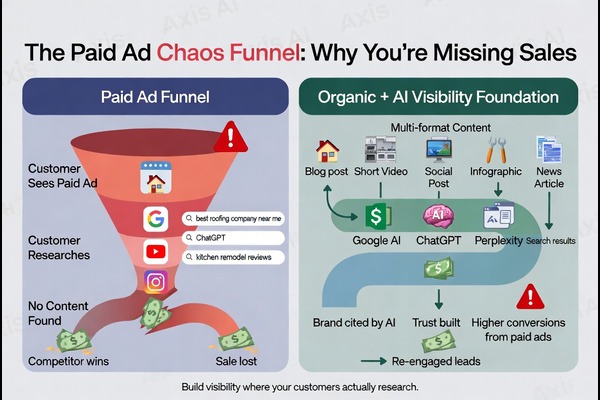
Then something predictable happens that most contractors never track or measure. The homeowner doesn't call immediately. Instead, like most buyers today, they begin researching. They open Google in another tab, ask ChatGPT about kitchen renovation costs, check YouTube for before-and-after videos, and search Instagram for local contractor reviews.
This research journey represents the most critical phase of the customer experience—and for most home improvement contractors, it's a complete black hole where qualified leads vanish.Companies like Axis AI understand this gap and have developed systems to capture leads during this crucial research phase rather than losing them to competitors who appear in search results.
Where Your Paid Ad Leads Disappear After the Click
1. The Initial Interest: Customer Sees Your Ad
The process begins innocently enough. Your Facebook or Google ad successfully captures attention and generates a click. The homeowner visits your landing page, absorbs some information, but doesn't convert immediately. This delay doesn't mean they're uninterested—it means they're being responsible with a major financial decision.
2. The Research Phase: Nearly Half of Homeowners Research Before Purchase
Recent data shows that 48% of homeowners research home improvement products online before making a purchase decision. This statistic underscores a fundamental shift in buyer behavior that many contractors fail to accommodate in their marketing strategy.
During this research phase, homeowners typically search for company reviews, compare pricing with competitors, look up contractor licenses and Better Business Bureau ratings, watch project videos on YouTube, and ask detailed questions in local Facebook groups or on AI platforms like ChatGPT.
3. The Content Gap: No Information Found About You
Here's where most contractors lose the sale they already paid to generate. When potential customers research the company name or specific services, they find little or no helpful information. Worse yet, they discover a competitor who has invested in creating valuable content that answers their questions.
The competitor's blog posts about "common kitchen renovation mistakes" or "how to choose the right roofing material" become the content that influences the final purchase decision. Your paid ad brought them into the market, but your competitor's content captured the sale.
4. The Lost Sale: Competitor Wins by Default
The final outcome is predictable but painful. The homeowner moves forward with the project but chooses a contractor they discovered during their research phase rather than the one whose ad they originally clicked. You paid for the initial interest but received zero return on that investment.
Why Attribution Tools Can't Track This Revenue Loss
Last-Touch Attribution Blindness
Most marketers still rely on last-touch attribution models that assign all conversion credit to the final click before a sale. This approach creates a massive blind spot in understanding the customer journey because it completely ignores the research phase where most purchase decisions are actually made.
When a customer clicks your paid ad, researches for several days, then finds your competitor through organic search and makes a purchase, last-touch attribution gives your paid ad zero credit for initiating that buyer journey. This makes paid campaigns appear less effective than they actually are while simultaneously hiding the revenue lost during research.
Platform Attribution Overlap Creates False Metrics
Attribution overlap occurs when different advertising platforms claim credit for the same conversions, creating inflated performance metrics that obscure which channels genuinely contribute to revenue. Facebook might claim credit for a conversion that Google Ads also attributes to its campaigns, making it impossible to understand true performance.
This overlap problem becomes even more complex when customers interact with multiple touchpoints during their research journey. A customer might see your Facebook ad, Google your company name, watch a competitor's YouTube video, and then call a third contractor entirely. Traditional attribution tools cannot track this complex path or measure the revenue lost along the way.
The AI Search Revolution Contractors Are Missing
45% of Consumers Now Use AI Tools for Local Service Research
The research landscape has fundamentally changed in the past year. BrightLocal's 2026 Local Consumer Review Survey indicates that 45% of consumers now use AI tools to find local services, representing a dramatic increase from just 6% one year prior. This shift means homeowners increasingly ask ChatGPT, Google Gemini, or Perplexity questions like "best roofing contractors near me" or "how much should kitchen renovation cost."
AI tools interpret user intent, location, and behavior to surface businesses that match complex, conversational queries, moving far beyond simple keyword matching that traditional search relied upon. This evolution requires a completely different approach to online visibility than most contractors currently employ.
ChatGPT Recommends Only 1.2% of Local Businesses
New research from SOCi's 2026 Local Visibility Index found that ChatGPT currently recommends just 1.2% of all local business locations when users ask for local service recommendations. This statistic reveals both a massive problem and an enormous opportunity for contractors who can position themselves to appear in AI recommendations.
The businesses that do appear in AI recommendations benefit from significantly higher conversion rates because AI tools provide personalized, conversational recommendations that feel more trustworthy than traditional search results filled with ads.
AI Provides Limited Curated Recommendations vs. Extensive Search Results
Traditional search engines display pages of results with multiple ads, giving users many options to compare and research. AI chatbots typically return only 3-5 recommendations for local discovery queries, making AI visibility crucial for being chosen among a much smaller set of options.
This limitation means that businesses appearing in AI recommendations face significantly less competition for attention compared to traditional search results. However, it also means that businesses not appearing in AI recommendations become completely invisible to this growing segment of consumers.
The Contractor Industry's Response Time Problem
Contractor Response Delays Cost Conversions
Industry surveys suggest many contractors take significant time to respond to leads—often long enough for homeowners to contact and commit to a competitor. This response time problem compounds the attribution gap because it creates another opportunity for potential customers to continue their research and find alternative options.
Homeowners making significant renovation investments typically conduct extensive research before contacting companies, which means they're likely evaluating multiple contractors simultaneously. Extended response delays give competitors ample opportunity to capture the lead through faster response times or better follow-up processes.
5-Minute Response Window Creates 21x Higher Conversion Rates
Research consistently shows that responding to a lead within 5 minutes makes a contractor 21 times more likely to convert it compared to responding after 30 minutes. This statistic highlights how critical immediate response has become in an environment where homeowners have multiple options and short attention spans.
The 5-minute window is particularly important because it occurs while the homeowner is still actively researching and hasn't yet committed to a specific contractor. After 30 minutes, they've likely moved on to researching other options or have already contacted competitors who responded faster.
How Return on Content Spend (ROCS) Beats ROAS Long-Term
Paid Ads: Average 4-8x Returns That Stop When Spending Ends
Most home improvement contractors see return on ad spend (ROAS) ranging from 4-8x when their campaigns are running effectively. However, these returns immediately cease when advertising spend stops, creating an expensive dependency on continuous investment to maintain lead flow.
Paid advertising also faces increasing costs over time as competition intensifies and platform algorithms favor higher-spending advertisers. What worked profitably two years ago often requires significantly higher investment today to achieve the same results.
Quality Content: Strong Returns That Compound Over Time
Well-executed content marketing can deliver substantial returns over extended periods because quality content continues generating visibility and leads long after it's published. A detailed blog post about kitchen renovation costs written six months ago can still be attracting qualified leads today without additional investment.
Content returns also compound over time as your library of helpful information grows. Each new piece of content supports and amplifies the effectiveness of existing content, creating a network effect that becomes increasingly powerful.
The Synergy Effect: Content Makes Paid Ads More Effective
Strong organic and AI-visible content also improves paid ad performance significantly. When homeowners research after clicking an ad and find helpful, authoritative information about your roofing, siding, window, or remodeling services, conversion rates often increase substantially.
This synergy means that content marketing and paid advertising support each other rather than competing for budget. Contractors who invest in both strategies see better overall performance than those relying exclusively on either approach.
Stop Losing Revenue You've Already Paid For With AI-Visible Content
The solution to the attribution gap isn't complicated, but it requires a fundamental shift in how contractors think about the customer journey. Instead of focusing exclusively on generating more clicks and leads, successful contractors are investing in capturing and converting the leads they've already paid to attract.
This approach involves creating detailed content that answers the questions homeowners ask during their research phase, optimizing that content to appear in AI search tools like ChatGPT and Google Gemini, distributing content across multiple platforms to maximize visibility, and implementing systems to re-engage leads who didn't convert immediately.
The businesses that implement these strategies now will capture market share from competitors who continue relying exclusively on paid advertising while facing increasing costs and decreasing effectiveness. The attribution gap represents both a significant problem and a massive opportunity for contractors willing to adapt their approach to match how customers actually behave in today's digital environment.
