
Blog Post
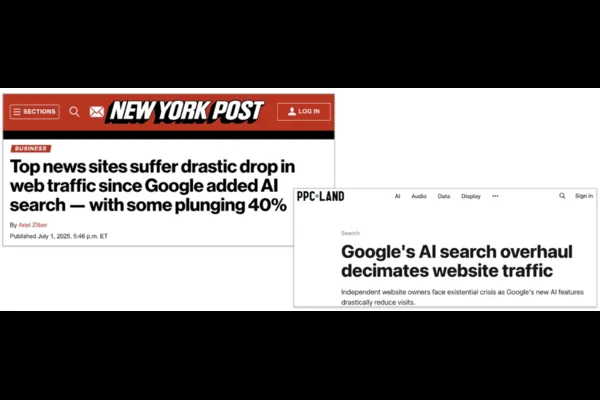
Did you know that Google’s AI mode has completely broken the internet home improvement contractors?
Key Takeaways
Google's AI Mode fundamentally changes how search results are displayed, prioritizing AI-generated summaries over traditional website links
Only 8% of searches with AI Overviews result in actual website clicks, compared to 15% for searches without AI summaries
Businesses must adapt their websites with tools like /llm.txt files to improve visibility in AI-driven search results
The December 2025 Core Update reinforces content quality standards and introduces new tracking metrics in Google Search Console
Early adopters who optimize for AI search are positioning themselves for better visibility as traditional SEO becomes obsolete
The digital marketing landscape has experienced its most significant shift since the introduction of search engines themselves. Google's AI Mode, which debuted in March 2025 and evolved with significant updates throughout the year, represents a fundamental transformation in how users discover and interact with online information.
Google's AI Mode Profoundly Reshapes Traditional SEO
Google's AI Mode operates as an intelligent assistant powered by Gemini AI technology. This system understands complex questions, synthesizes information from hundreds of trusted sources, and maintains conversational context across multiple queries. The result is a dramatically different search experience that prioritizes AI-generated summaries over direct links to websites.
Traditional SEO strategies that focused on keyword optimization and link building are becoming increasingly ineffective. The AI system doesn't simply match keywords—it comprehends user intent and provides detailed answers that often eliminate the need for users to visit individual websites. This shift represents what industry experts call "The Great Decoupling," where search visibility increases but actual website traffic decreases significantly.
For businesses that have invested years in SEO optimization, this change feels seismic. However, understanding how AI Mode functions opens new opportunities for visibility. Axis AI has developed specialized strategies to help businesses navigate this transition effectively.
What AI Mode Means for Your Business
1. AI-Summarized Results Replace Direct Website Clicks
When users search in AI Mode, Google's Gemini technology curates concise overviews that directly answer queries without requiring clicks to source websites. These AI-generated summaries pull information from multiple sources, creating detailed responses that satisfy user needs immediately on the search results page. This fundamental shift means businesses can no longer rely solely on attracting clicks to drive traffic and conversions.
The AI summaries are highly structured and relevant, often providing more complete answers than individual website pages. Users receive immediate value without navigating away from Google, changing the entire dynamic of online discovery. Businesses must now consider how their content will be interpreted and synthesized by AI systems rather than how it will attract human clicks.
2. Only 8% of Google Searches with AI Overviews Result in Website Clicks
Recent data reveals that searches featuring AI Overviews generate clicks to actual websites only 8% of the time, compared to 15% for traditional search results without AI summaries. This statistic represents a dramatic reduction in potential website visitors when AI takes control of search results presentation.
The implications extend beyond simple traffic metrics. Businesses are experiencing what researchers term "visibility without visits"—their content may be prominently featured in AI summaries, providing brand exposure and authority, but generating significantly fewer direct website interactions. This trend forces a complete reevaluation of how success is measured in digital marketing.
3. Your Website May Experience Significantly Reduced Visibility
AI Overviews are reducing website clicks by over 30% across all industries, even as search visibility metrics appear to increase. This paradox occurs because AI systems can access and summarize website content without directing users to the original sources. Websites that haven't adapted their content structure for AI interpretation may find themselves completely overlooked by these systems.
The most concerning aspect for many business owners is the potential for AI systems to present outdated or incomplete information about their companies. When AI tools cannot properly access or understand a website's content, they may rely on third-party sources or older information, leading to misrepresentation of products, services, or company details.
The December 2025 Core Update Brings Significant Changes
Building on Previous AI Content Quality Updates
The December 2025 Core Update significantly reinforces the evaluation of AI content quality within its broader content quality assessment. This update directly evaluates AI content authenticity and broadens the E-E-A-T (Experience, Expertise, Authoritativeness, Trustworthiness) requirements to virtually all competitive search queries. The update builds upon previous algorithm changes but introduces unprecedented scrutiny of AI-generated content.
Unlike previous updates that focused primarily on traditional ranking factors, this update specifically addresses how AI systems evaluate and present information. The algorithm now distinguishes between AI content that provides genuine value and AI-generated content designed merely to manipulate search results. This distinction becomes vital as more businesses attempt to optimize for AI-driven search.
New AI Mode Filter Added to Search Console
Google has introduced a dedicated "AI Mode traffic" tracking system within Google Search Console, providing marketers with unprecedented insight into how their content appears in AI-generated search results. This new metric tracks how often content is featured in AI Mode results and whether those appearances lead to clicks, offering valuable data for optimization strategies.
The AI Mode filter represents a significant shift in how businesses can measure their digital performance. Traditional metrics like organic search traffic must now be supplemented with AI visibility metrics. Companies can now track citation rates in AI summaries, understand which content performs best in AI contexts, and identify opportunities for improvement in AI-driven search results.
How to Optimize Your Website for AI Mode
1. Test Your Current AI Visibility
Begin by assessing how AI systems currently interpret and present information about your business. Search for your company name, products, and services using Google's AI Mode to understand what information appears in AI summaries. This baseline assessment reveals gaps between your intended message and how AI systems represent your business.
Pay particular attention to the accuracy of information presented in AI Overviews. Note any outdated details, missing services, or misrepresentations that could confuse potential customers. Document these findings as they will guide your optimization efforts and help prioritize which aspects of your digital presence need immediate attention.
2. Consider Creating an llms.txt File
The llms.txt file is emerging as a recommended tool for businesses wanting to maintain control over how AI systems interpret their content. This special text file, located in a website's root directory, helps AI systems and large language models process website content more accurately and efficiently by providing structured summaries of important information.
Companies like Vercel have successfully implemented llms.txt files with contextual descriptions, enabling AI agents to make more informed decisions about content relevance and accuracy. Early adopters of this standard may gain significant advantages as more AI tools integrate support for these files. The implementation involves creating a clear, structured summary of your business's key information, products, services, and unique value propositions.
3. Structure Content for AI Summarization
AI systems excel at processing clearly structured, hierarchical content with defined relationships between topics. Reorganize website content using clear headings, bullet points, and logical information architecture that makes key details easily extractable. Focus on answering common questions directly and concisely, as AI systems favor content that provides immediate, actionable answers.
Consider how your content will be interpreted when stripped of visual elements and formatting. AI systems primarily process text, so ensure that critical information is communicated through words rather than images, videos, or complex layouts. Create content clusters around specific topics, making it easier for AI systems to understand your expertise and authority in particular areas.
4. Focus on Getting Cited in AI Overviews
Getting cited in Google's AI summaries has become a vital new metric for digital success. These citations provide brand exposure and establish authority even without generating direct clicks. To be eligible for inclusion as a supporting link in AI Overviews, pages must be indexed and eligible to be shown in Google Search with proper snippets, adhering to all technical requirements and policies.
Develop content that serves as definitive resources on specific topics within your industry. AI systems favor authoritative content that can serve as reliable source material for summaries. This approach requires shifting from keyword-focused content to topic-focused expertise that demonstrates deep knowledge and understanding.
Businesses Adapting Early Are Better Positioned for AI Search Success
The businesses that recognize and adapt to AI-driven search early are positioning themselves for long-term success in this new digital environment. While traditional SEO focused on competing for top search positions, AI optimization focuses on becoming the most reliable and authoritative source of information on specific topics. This shift rewards expertise and authority over manipulation and keyword stuffing.
Companies that implement AI-friendly content structures, create structured llms.txt files, and focus on getting cited in AI Overviews are building sustainable competitive advantages. As more users adopt AI-powered search tools, these early adapters will maintain visibility while businesses clinging to outdated SEO strategies become increasingly invisible.
The transition period offers unique opportunities for forward-thinking businesses to establish themselves as authoritative sources in their industries. By understanding how AI systems evaluate and present information, companies can ensure accurate representation and maintain customer connections even as search behavior evolves dramatically.
Axis AI specializes in helping businesses navigate the transition from traditional SEO to AI-optimized digital strategies, ensuring companies maintain visibility and growth in the evolving search environment athttps://axisai.us/free-ai-report
